Sunday, January 29, 2012

i carry you with me...


i carry your heart with me(i carry it in
my heart)i am never without it(anywhere
i go you go,my dear...


here is the deepest secret nobody knows
(here is the root of the root and the bud of the bud
and the sky of the sky of a tree called life;which grows
higher than soul can hope or mind can hide)
and this is the wonder that's keeping the stars apart

i carry your heart(i carry it in my heart)
e.e. cummings


Tattoos as a form of ritual and meaning are not a recent phenomena. The art of tattooing occurred even 5000 years ago. It is said that during the Crusades, Christians tattooed a cross on their hand or arm to ensure they would receive a proper Christian burial.

Bereavement or memorial tattoos using concrete or metaphoric images have become widely popular in the past several decades as adaptive mourning rituals. Grief rituals contain symbolic elements, presence of emotions, presence of spirituality, meta-awareness of performing rituals remembrance, and chosen others to participate in the ritual” (Gowensmith, 2000).
I've had several regular readers ask me to post more information about my back tattoo. The reason for my own tattooing is very intimate. I do it mindfully so that I may mark those profound experiences of suffering, love, and transfiguration. And also, to furrow those enduring connections to my beloved Dead deep in my being.
The above photo was taken last week at Red Rock Crossing in Sedona, Arizona by Tim Condron, an amazingly talented photographer. It says:

The soul still sings in the darkness telling of the beauty she found there; and daring us not to think that because she passed through such tortures of anguish, doubt, dread, and horror, as has been said, she ran any the more danger of being lost in the night.
Nay, in the darkness did she, rather, find herself.

--St. John, Dark Night of the Soul

There are two alchemical symbols at the bottom of this verbiage, one for brass and one for gold. They represent something Sant Keshavadas once said which rendered me speechless:

Go ahead, light your candles, burn your incense, ring your bells, and call out to G*d, but look out. Because G*d will come and He will put you on his anvil and He will fire up his forge, and He will beat you and beat you until He turns brass to pure gold.

For me, there were no two more meaningful proclamations about the dark night of soul that so many traumatically bereaved endure. From formlessness into the kiln, and from the kiln into transformation.

The tattoo was done by a local artist, Siva Om, and they contain the ashes of my dead child.

To some, this may seem macabre.

To me, it is pure love born of the fire. And now, everywhere I go,
"i carry ^her^ with me"


*********************

If you have a memorial tattoo, what does it mean for you?


Wednesday, January 25, 2012

G*d closed my eyes: Now I can see


"For a man to truly know his path, he must close his eyes and walk in the dark."
San Juan de la Cruz


The movie, Bella, was one of my favorite "happy-ending" films of all time. In particular, this scene moved me to tears.

G*d closed my eyes: Now I can see.

Those words, the first time I saw the film, elicited tears from deep within the well of my heart.

Sublime.

Blindlessness is the ability to look but not really see. I've been practicing mindful seeing for several years now ("practicing" being the key). And the world truly comes alive when we truly see it.

People. Emotions. Stones. Insects. Blinking lights. Engines. Cold breezes. Birds. Detritus. Flowers. Clouds. Soil. Garbage. Did I say people?

I've been noticing a man who is blind recently. I've seen him three times. And as I've watched him circumnavigate the neighborhood, I found myself marveling at the way he truly sees and knows the world far more intimately than I.

While at Starbucks this morning, I stood behind two people, as a large crowd came through the door. At the end of this crowd was the man who is blind. He came in last, behind the others. I watched him come through the door slowly, his probing cane leading the path, and he lined up, with deliberate accuracy, seven customers behind me as I was ready to place my own order.

Spontaneously as I placed my order, I surreptitiously added a $20 gift card for the cashier to give him anonymously. I didn't have a Kindness Project card ready, but it didn't matter at all. I whispered to the cashier, "If he asks, tell him its because of his beauty in the world as part of the Kindness Project."

I hurriedly left and sat in my usual spot outside, around the corner, thinking about my own sight, both the literal and the figurative. And my home. And my family. And my job. And two legs. And food and running water. And friends. And Chey... and feeling thankful. Yes, thankful.

About 15 minutes later, he came out, his coffee in hand, and with an ear-to-ear smile that brought tears to my blindless eyes.

Perhaps, in that moment, and without even knowing, that stranger opened my eyes so that I could really see.


Tuesday, January 3, 2012

FOX News and Alan Colmes: Is there any historical memory at all?


There is outrage and deep sadness in the world of bereaved parents. Alan Colmes, of FOX News, called Republican Presidential Candidate, Rick Santorum, "crazy" for spending time at home with their newborn baby, Gabriel, who died two hours after birth.

Now, I don't talk politics because they are private and I prefer to protect my political views. What is not private about me is that I am fiercely pacifistic, give often and freely to charity, believe that human beings have a moral and spiritual responsibility to care for one another, and that I care deeply about Mother Earth, exemplified by nearly four decades of vegetarianism and other lifestyle choices. I will also say, and this will not surprise my readers, that I would not vote for Santorum.

So, politics aside, what Alan Colmes said was despicable. Not only despicable, but ignorant. In addition, the public commentary is even more disturbing. People politicizing the apolitical. The death of a child is not partisan. And I'm guessing that how much a parent loves and attaches to his or her child has nothing to do with being red or blue or green or tea. Jacques Ellul, law professor and philosopher, speaks of this politicization process in the book Political Illusion:

"...The first great evil from which most other evils spring is politicization (the act of suffusing everything with politics and dragging it into the political arena)... Anything not political does not arouse widespread interest; it is not accorded any independent existence in our politicized world."

Politicizing the death of a child.

Beyond that egregious violation, the thanaphobia and ignorance of death in our society continue to astound me. Public comments such as: "It's morbid to spend time with a dead body," and "Who wants to be around a dead person?" and "Only creepy people touch the dead" and "That's just not normal" baffle me.

Actually, on the Gaussian curve of history, the entire idea of strangers taking care of our dead is the abnormal thing. Do people truly believe the funeral industry has existed for centuries? Uh. Who do you suppose took care of the dead 100 years ago? Heck, 50 years ago in some places. Families did. And it was often a much more humane and healing process of farewell. Yes, people took care of their own dead. The institutionalization of birth and death, occurring around the same time, is a contemporary phenomena. Bringing your child home after death is common practice in many areas of the Western world today (New Zealand and Australia for example). Dead children were laid out in the White House. Today, indigenous cultures continue take care of their dead. And, the home funeral movement is making a strong comeback. Ethnocentrism = nonplussed. Has this "expert" ever taken an anthropology class or has she counseled bereaved parents for 15 years or has she been with a mother who had to give birth to a baby prematurely knowing the baby will die, or has she been with a father who just found his dead infant in the crib or has she been with a family in the hospital whose teenager was just struck by a car or with a family whose young child was dying of cancer or been with a family as they disconnected their child from life support? No? She hasn't? Well, in that case, Helen Merrell Lynd has something to say to this expert and others who engage more in judging, shaming, and blaming others than expressing metta (loving kindness) or karuna (compassion) to others:

It is relatively easy to entertain multiple possibilities of truth and of right action if one remains a spectator on the sidelines.

-Helen Merrell Lynd


People. Get over your death anxiety/aversion/fear/avoidance. Death is, as Anne Morrow Lindbergh noted, the "great leveler". Let's hope its never your child, but even if its not, someday someone you love very, very deeply will die. Death will mark you. I assure you. Death will mark you. And He is a great teacher. Being with Death and accepting the reality of your fate- and the fate of all those you love- will make your life bigger, not smaller. Ritual is normal, human, and a sacred part of the human experience.

So, if you dare and if you have the courage it takes to live a very big life, take a glimpse into the life of Layla, a beloved friend's baby girl (*emotional*). We can learn much from this precious little child.

Parents have the right to say farewell to their child in any way they feel compelled. Some may choose to spend as much time with their child's body as possible. Some take memento mori photos, very common during the Victorian era and also very common in perinatal death because of the lack of tangible memories. Absolutely normal. Some will take a lock of hair, a foot and hand print or mold. Some will kiss their child's lips, hold them closely and say things they need to say. Some will drape their child's lifeless body across their lap- think Michelangelo's La Pieta. Some will choose otherwise, and some regret their choices.

In my 15 years of both clinic practice and research, most parents who do the former do not regret their decision to be with their beloved dead child. Many parents who choose the latter, who feel in the moment that they cannot tolerate the emotional surge and so turn down the chance to be with their child, or as Kristi-mother of beloved Danny says "bow" to the pressure of others- do regret it. Not always, no, but very often. Either way, to assert that this behavior is "crazy", as if no one in history has ever or would ever want to see and hold their child who died or is dying- well- it causes me to ponder what university issued that degree...

The MISS Foundation has issued a press release in response to this unbelievably cruel and ignorant blunder. I would hope that Mr Colmes would be mature and wise enough to respond swiftly with humility and compassion, bowing his head to bereaved parents around the world and asking their forgiveness.

Sadly, I'm not optimistic. This is, after all, politics. Colmes- give me a call. We'll talk.


The MISS Foundation Asks for Apology from Fox News to All Bereaved Parents

MISS Foundation families were shocked to hear the comments issued from Alan Colmes on Fox News on January 2, 2012. Mr. Colmes’ reference to Mr. Santorum's baby who died, and his desire to spend time with the baby's body during the postmortem period, as "crazy" exemplifies his lack of compassion, intelligence, or historicultural wisdom.


Quote startTo hold, see, photograph, spend time with our children after their death is a privilege, honor, and deeply important part of the ritual of grieving. It is not "crazy."Quote end

Phoenix, AZ (PRWEB) January 03, 2012

MISS Foundation families were shocked to hear the comments issued from Alan Colmes on Fox News on January 2, 2012. Mr. Colmes’ reference to Mr. Santorum's baby who died, and his desire to spend time with the baby's body during the postmortem period, as "crazy" exemplifies his lack of compassion, intelligence, or historicultural wisdom.

"Throughout history, humans have spent time ritualizing and saying farewell to their beloved dead. Mr. Colmes’ portrayal of such an innate and natural experience revealed far more about Mr. Colmes’ character than Mr. Santorum’s," said Dr. Joanne Cacciatore, founder of the MISS Foundation and a researcher and professor atArizona State University who studies parents experiencing the death of a baby. "This is absolutely normal and common and can reap significant psychological benefit. Spending time with their baby after his or her death is important to many families, according to my research."

The willingness of Fox News to air Mr. Colmes' portrayal revealed the deep-seated ignorance of our culture that is perpetuated by a very judgmental media. Beyond insensitive, the comment aired on the Alan Colmes show was more than a cheap shot. It was a slap in the face to bereaved parents. The death of a child can happen to anyone, it knows no boundaries of race, creed, religion or political affiliation. Attacking bereaved parents to score political points or using bereaved parents to further political goals is beyond shameful.

The MISS Foundation is glad to hear Mr. Colmes apologized to Mr. Santorum, and now, on behalf of millions of bereaved parents around the world, the MISS Foundation is asking Fox News and Mr. Colmes for a public apology to all bereaved parents. Cacciatore continues, "To hold, see, photograph, spend time with our beloved children after their death is a privilege, honor, and deeply important part of the ritual of grieving. It is not "crazy." Rather it is a choice, a practice, and a skill of choosing to be emotionally vulnerable and present to the resilience we are all capable of after grief comes -- if only we were all supported instead of ridiculed."

The MISS Foundation is a nonprofit 501c3 organization that CARES for families before, during and after the death of a child of any age and from any cause. For information about services the MISS Foundation provides, visit:http://www.missfoundation.org, email kathy.sandler(at)missfoundation(dot)org or call 888-455-MISS (6477).

###


Saturday, December 31, 2011

The Irrelevance of Time


ABC News recently published an article about a research study: Bereaved parents can die of broken hearts. Literally.

Yes, yes. We know this.

We bereaved parents know this.

Even if we physically survive our child's death, most of us experience the 'death' of our former self, and have to choose to be reborn- transfigured- into another being. Our worlds, too, are transformed.

Nothing, and I mean nothing, is the same. Ever. No sunset or sunrise is ever the same. No finch's call. No lapping wave. No moon glow. No north star's shine. No drive home. Nothing.

Time becomes irrelevant.

The past and future merge into every present moment, and time stands as a soldier waiting. Waiting for the pain to ease. Waiting to hear their voice. Waiting for others to understand. Waiting for some relief. Waiting to hold them again.

Time was irrelevant for me in 1994. Time is irrelevant in 2012. Yet, time seduces us with its illusion, doesn't it?

Until a few years ago, I found myself searching for her in the eyes of other girls with their long legs and their rock band t-shirts and their bubble-yum breath and their straw-colored hair. My eyes would pan the crowds for her identity. I knew that, for me, one way for me to quench that longing would be to transform the evanescent into the tangible. Tricking time, the photograph is an age-progressed forensic drawing, masterfully created from six newborn photos, of Cheyenne...

This is what I lost. And everything between 1994 and this picture. And everything from this picture until I take my own final breath. This is what I lost. Do you see her? Isn't she beautiful?

I no longer search for her in crowds, scanning the eyes of strangers and wondering... Like a cheap psychological trick against time, the charlatan, for a moment, is fooled.

And for that, I am thankful. Speaking of thankfulness...

It takes many years and a lapse of time- and much, much work- for bereaved parents to unearth the type of beauty, and gratitude, and pure joy, and vibrancy for life (speaking of time lapse, that is a link to a must see TED) which rivals the pain, loss, shame, guilt, suffering, and despair.

It remains, for me, one of the great mysteries of the human experience. That is, how the darkness tears our lives open and empties us into the giant chasm of the mysteriously unlimited. Time not only stands still but it feels irrelevant in moments of such profundity. My life has not grown smaller from the grief; it's grown larger, less constricted, more meaningful, and with a depth and breadth I'd not have imagined 17 years ago.

Ah, but what would I give to have her back?

All.of.it.

Zora Neale Hurston, in Their Eyes were Watching G*d, wrote:
A thing is mighty big when neither time nor distance can shrink it.

I trust that until we are together again, time will continue to be irrelevant, a mere drop trickling into the ocean of the love we share. And I trust that one day, I'll awaken and I'll hold her again, wherever and in whatever way that may be.

And I will understand why time and space was so inconsequential in the big-ness of her death.

May each of you experience the irrelevance of time as 2012 arrives with its hopes and wishes and aspirations. May you feel only the love, the big, boundless love that dwarfs time, space, and Death.

And to you, little-big girl: I love you Chey. Neither time nor space is relevant in our place of love. I just love you. Timelessly.

***************************************************************************
To the girl who would've been her best friend-
who hiked barefoot like me
and who was a proud, tree-hugging herbivore-
Happy 19th Birthday Katie Eide.
Your mom and dad love and MISS you so much.
Tell my girl hello and that I love her.
Can't wait to meet you.

Tuesday, December 6, 2011

The Great Ocean of Sorrow


This has been a long, hard week. Sadly, many newly bereaved families joining our tearful tribe; many calls from the 'parking lot' of Christmas crises; and too much work with very few resources contributed to this 90+ hour work week. Exhausting.

When I'm exhausted, I know what to expect. I'm much more emotionally fragile, and that's okay with me. That is, when I'm not driving.

So, tonight, at 11:30pm while commuting over the long 125 miles from support group at the MISS Foundation office in Phoenix back home, I had what I'll call an ebb of contemplation which turned to sadness which turned to anguish which turned to you'd-better-pull-off-the-freeway-now-before-you-can't-see moment.

And so I did.

I cried and cried. Got back on the road. Pulled over again. And cried and cried.

Uh. Apparently, it was my time?

Okay, okay, okay. I get it.

Deep breaths, when ready, and back on the road.

I made it almost home before the tears came again. By the time I got into my driveway, it would be the full-on, gasping, suffocating, swallowing gulps of air kind of sobbing. I stood outside myself as it was happening: "Isn't this interesting?" I asked my subjective self. "What the heck?" I wondered. "What brought this on tonight?"

I went through the list.

Exhaustion. Check.
Emotional mimicry. Check.
Time of year (Merry? Merry? Really??). Check.
I just miss her. Check.
She should be here. Check.
Really feeling her non-physical presence. Check.
I don't wanna do this anymore. Why do I have to do this? Double check.

20 minutes later, and I pulled down the rear view mirror, wiped off the mascara from my face, and came into the house.

Sitting on the table was a box with my name on it. I recognized the return label as a woman I'd interviewed for a research study this summer and the summer prior. She is from a totally different region of the U.S., a sub-sub-sub-sub culture with virtually no shared commonalities with me. And yet, with the most important of all single commonalities: She is a bereaved mother. Her beautiful 8-year-old son died in a farming accident. I opened the package. Out fell a card and a rectangular shaped gift wrapped in Easter paper.

The note said that she was, of course, sad for why we met. But that she "rejoiced that G*d chanced our paths to meet..." and that she thinks of me "so often" and how I've helped her. She had bought something for me at a thrift store... something I'd seen in her sister's home during the research study, and mentioned that it was a powerful image.

This grieving mother wanted me to have this as a token of gratitude.

I gently tore open the pastel wrapping, imbued with painted eggs and bunnies with fluffy tails, and found the painting, and I cried more. It is the image of a man, head bowed, hands together, praying or meditating, somber. I imagine him to hold deep sadness in his heart. I imagine his child died- or his wife- or his mother. I imagine he feels alone in the world. I imagine he doesn't sleep or eat much anymore. I imagine breathing is painful for him. I imagine many things about this man's grief, his story of life and loss and death...

I cannot express in words what this small token from her meant.

"Goodness, what's next tonight?" I thought to myself (dare I ask?).

I sat with my many emotions for awhile, and ended up in deep meditation, leading to some prajna around my emotional fragility. What came to me was this thought:

My tears are not my tears alone. My tears fall into the creek near my home, which lead to the river miles away, which then lead to the great ocean of sorrow; in this place, other creeks and rivers have carried the sorrows of many other mothers, and fathers, and sisters, and brothers, and grandparents, and friends, and aunts, and uncles, and neighbors, and strangers who have also deeply mourned. The myth of separateness is an illusion to keep us safe from vulnerability but which stifles realization of our connectedness; this great ocean of sorrow merges many to one, the knowing into the unknown, the wisdom into the wonder, and the questions into the big mystery, throughout history and across land masses and beyond culture. Every tear I shed tonight and all the countless tears shed over the past 17 years and five months since her death is a part of the painful love story in that great ocean of sorrow, where the tears of many others, yours included, have emptied into this vast ocean. We may not even speak the same language, yet we know one another more intimately than most all others. Our tears unite us through the pangs of longing and the unified sadness and horror and despair. And I know that I am not alone in my suffering.

And neither are you.

Hold that truth deep within your heart.

And neither are you.


She weeps when she is alone.
She hopes when she is able.
She longs every moment of every day.
She breathes only because she must.
She wishes it was different.

She would give her life for her child.
This is a mother's love.
She is a grieving mother.


Thursday, December 1, 2011

Sarah Love, full of her name


Thank you, Sarah Love and Arizona Foothills magazine for this lovely article about my work with the MISS Foundation. I do not exaggerate when I say that the recent two years of increased attention to the MISS Foundation from local media venues has been truly astonishing.

Listen- people are starting to hear and see you, bereaved parents. The world is hearing your collective voices... your children's collective voices. The silence of the bereaved will soon be a "once upon a time" story.

I want to send a very grateful nod to the little boy, RST, who is helping move this along at a very rapid pace. Thank you little man, and your mama.

The direct link to the article is here or you can read most of the interview:

Most of you know her as Dr. Joanne Cacciatore, founder of the MISS Foundation and professor and researcher at Arizona State University. Her expertise is helping those affected by traumatic death. As a mother of five, as she says, “four who walk and one who soars,” she understands how these parents are affected by this tragedy. These aspects made her start this nonprofit organization with 75 chapters around the world. These chapters help aid parents whose children are in the process of dying or have already died. As an advocate of “green” mental health care, she is also a member of Associations like the American Psychotherapy Association and more. Her work has been featured in People and Newsweek magazine, the New York Times, Boston Globe, CNN and more.

Arizona Foothills Magazine: In your words, what is your foundation and your main goal?

Joanne Cacciatore, PhD: Every day in the United States and beyond, infants and children die. The MISS Foundation has grown from a small, local nonprofit agency, which I founded in 1996 to a huge international nonprofit with 77 chapters around the world. The MISS Foundation C.A.R.E.S. for families who are enduring life’s worst tragedy- the death of a child. We can’t save children, so we help save their families. We focus our efforts on counseling, advocacy, research, education, and support- thus the acronym C.A.R.E.S.


AFM: How does it feel to do something amazing and give back and help counsel those in need?

JC: Well, it’s a bittersweet calling without any doubt. The degree of suffering I lmean, can you imagine, for a brief moment, what would happen in your family if a baby or a child were to die? Unspeakable and unthinkable loss. Yet, I am able to join them in their suffering and endure the pain with them as we navigate their own unique experience of traumatic grief. Not everyone has the tragic privilege to work with these profoundly beautiful families. The children who died—those are the really amazing ones—from beyond this world, they inspire us to live more fully, love more deeply, and to more fully inhabit our own lives. I feel honored to know all these children through their parents, grandparents, siblings, aunts, uncles and friends.

AFM: While in college, did you know this was the path you wanted to take? What pushed you into this field?

JC: This work was my calling. In 1994, my baby daughter, Cheyenne died, from unknown causes. I was catapulted into a dark night of the soul that would literally change my entire world. I could barely get out of bed many days, and I was in deep, dark abyss for a very long time. She died on July 27, 1994, and sometime in October, I made a promise to my dead child that if I survived the pain, because I wasn’t sure I would, I would make sure other families enduring this tragedy would not need to endure it alone. I started the MISS Foundation in 1996 making good on that promise to her. I hope one day I will see her again, in whatever way that might be, and that she will smile knowing that I lived up to that promise.


AFM: Tell us about an experience or moment that has touched or moved you, something you will not forget.

JC: There are far, far too many for me to describe. I will tell you that I have received thousands upon thousands of letters from people around the world thanking me for this work, from Romania to Africa to Italy to New Zealand. I learn something profound from every family, from every child who died. My heart grows bigger from every experience, and its truly the most rewarding, albeit tragic, work to which a person could commit his or her life.

AFM: This foundation is about helping others. What have you learned about yourself?

JC: I have learned that the capacity for a human to bear suffering is equivalent to their capacity to experience love. The reason for big suffering is big love. From exploring death, from facing death every day, I have learned to truly live. That is a gift, a gift I believe few know or discover. A gift for which I am grateful.

AFM: What is the process of helping families discover hope?

JC: I’m not sure I see that as my role. I join them in their suffering so they do not suffer alone. I know many do experience hope as a byproduct of having a willing witness to their pain, and that is a truly magical thing—to feel despair and then to discover there may be hope. I suppose I help them be with what is true for them, moment-by-moment, and the hope and the healing come, organically, from that relationship.

AFM: You say, “I don’t want to merely survive. I want to become.” How does this foundation make you “become”?

JC: I become more fully human by being a willing student of life. Every day of my life I am becoming more fully human. I learn from my students at ASU, I learn from the ant working in my yard and the clouds moving across the sky. I learn from my work at the MISS Foundation. I hope I’m becoming and learning and growing and evolving from now until I take my final breath. I believe that hubris incites stagnation, and I never want to be in that place. Humility is key. And death keeps us very, very humble.

AFM: You also said, “The more I am present with the reality of human suffering—my own and others—the more genuine and full life I am able to lead.” How does this make your life more fulfilled?

JC: It is impossible for anyone to escape human suffering. Someday, someone you love very, very, very much will die. And you will experience grief; profound suffering that will bring you to your knees. No pill, no wand, no magic spell, no prayer or mantra or bottle or book will fix it. Human suffering is a part of the human experience. When I constrict my willingness to enter the dark places, to truly feel the suffering of my life and my loss, then I also restrict my capacity to feel the kind of big, rushing, capacious love and joy and passion for life. The poet, Gibran, said that only ‘he who has looked into the eyes of sorrow will ever truly look into the eyes of joy.’ I absolutely believe that. We numb or distract or evade or deflect any of our painful emotions and we risk fragmentation our true selves. Our world becomes very, very small and very limited.

AFM: What impact do you hope to have on the future?

JC: I hope to see many more skilled practitioners in the area of traumatic grief. I direct the Graduate Certificate in Trauma and Bereavement program at ASU to help train specialists in this area. Frankly, there aren’t enough trained providers in the United States to help the numbers affected by traumatic death. I’d also love to see the MISS Foundation offices in all major cities around the world. We have a misperception that traumatic death is a ‘family’ issue. It’s not. It’s a social issue that affects every one of us. The effects of child death, in particular, are far more enduring that people realize. I’ve spoken to many families who talk about their grandmother’s loss and how ‘she was never the same after that’ or how ‘our family changed forever.’ We can, together, create a more sane and compassionate world for the bereaved. But it begins with education and a willingness to tolerate very, very painful and traumatic human experiences.

So ultimately, before my own death, I’d love to see the world transformed into a more tender and compassionate place for those suffering. Those are some big aspirations, indeed!

AFM: To those who want to help, what do you recommend?

JC: We desperately need funding. As you can imagine, the topic of infant/child death is hardly sexy for grantors, and thus we struggle obtaining financial support from philanthropic groups. We need skilled board members who can help in meaningful ways and who have connections to key community leaders. If folks are interested in our mission, a mission of the heart, mind, and soul, please feel free to contact Kathy Sandler, MSW at Kathy.Sandler@missfoundation.org or call the office at 602.279.MISS.

Many, many thanks for reading about our organization!

Sunday, November 13, 2011

Kindness, Compassion, and Connor...

Me and Connor at the Evening of Kindness
a fundraiser for the MISS Foundation

Connor and his little brother, Kyle
who offered the money they were paid for the night as a donation to our cause


The heart knows neither duality nor the limitations of time and space.
-Sri Sathya Sai Baba


Last night I spoke at the MISS Foundation's fundraiser 'An Evening of Kindness' to celebrate the more than 1,000,000 Kindness Projects which have been done (literally) around the world since the project's inception in 1997.

The event was held at the Merrill Estate in the generous spirit of Bruce and Janis Merrill, and with the aid of many amazing volunteers to whom I am eternally grateful.

Valley business leaders, philanthropists, and those touched by the work of the MISS Foundation attended. Ambassadors Maya and Woody Thompson came in memory of their beloved, gorgeous little boy, Ronan Sean who died in May of this year as a result of neuroblastoma. Leroy was there remembering Jason. Shawn and Theo were there remembering Zach. Melissa was there to honor Tyler. Michele was there to talk about International Kindness Project Day on July 27th and to remember Branden and to thank the compassionate folks at Circle K for helping Michele "be his mom for a day." Kathy was there to remember Lizzy. Mark and Sandie brought photos of Zach and Katie to share their love and their lives. And many, many more... Kathy Sandler's two children, who also worked the event, donated their money back to the foundation. Even the guitarist, hired from Flagstaff, decided to donate his time after the event in memory of his beautiful sister, Mandy.

To say there were many emotional moments and much, much suffering in the room would be an understatement.

Simply, there is no material place on Earth which can hold the anguish in that room last night. No matter how many beautiful kindnesses are born from the pain of this loss, the means never justifies the end. Ever. Still, exploring the beauty from pain is a choice we get to make, when we are ready, as bereaved.

I want to share one magical interaction I had with a young man, Connor, who reminds us that we have much to learn about time and space and age and wisdom. Our greatest teachers are, often, the youngest...

After all the speakers presented, Connor approached me. He had been volunteering all night, and I'd noticed his warm smile and quiet demeanor. He thanked me for our work, and he said that he nearly cried while I was speaking. He looked into my eyes and I could see and feel his compassion. Those moments are all too rare in this chaotic, no-time-to-pause-for-the-pain world. Yet, standing before me was a very young man who had given pause to my words and clearly felt them deep inside his heart. He said that he wanted to donate his earnings for the evening to help the MISS Foundation. He believed in our cause. My eyes started welling with tears. His did too. We just stood there looking at each other for a moment... this young man, a stranger, who opened his heart so far and wide, with such breadth and depth that time literally stood still. It's a rare thing in this world. I knew I was standing in the presence of a giant, and I was humbled.

As he promised, at the end of the evening, Connor approached me to hand me his earnings. So did his wonderful younger brother. They wanted to give. They weren't afraid of us like others often are. They did not recoil at the talk of child death. In the only way they could help, they wanted to help.

There were so many, many more magical moments last night. People who came to me and shared their sorrows and their losses and their sufferings. Those are the things which remind us of our humanity, of our shared connections to one another and to the bigger picture. I'm reminded of Trungpa Rinpoche's admonition to "hold the sorrows of the world in our hearts while still remembering the great Eastern Sun."

Connor and I exchanged numbers as he is off to college next year. He promised to stay in touch and offered to volunteer again until graduation next May. I want to express my gratitude and respect to his parents and his grandparents and his aunts and uncles and other family members who helped to raise him (and his brother) and who must have a surplus of generational loving compassion, as it obviously spills over his own heart and into the hearts of others.

And if those magical moments were not enough, in a Jungian twist of synchronicity, I discovered that Connor was born on the day we buried Cheyenne in 1994, and I wept. I imagine she'd have liked him very, very much too...


Monday, November 7, 2011

The Paradox of Suffering


Yesterday I received an email from a delightful Italian man I met long ago. I didn't realize, ever, that he followed my blog:


I have been reading your blog, and I have a question for you: are you able to be happy? to have lighthearted moments? to laugh without a worry in the world? Or is the dark cloud of grief always hanging over your head? I know, this is none of my business. But I have been wondering this for a long time and I only got the courage to write you today.

Those who do not know me personally and intimately might believe my life to be macabre, full of sadness, grief, trauma, and loss. Oh, yes, and in fact, I cry nearly every day.

But, there is another aspect of me often unshared publicly because traumatic grief is the centerpiece of my work's nature. Here is my response to this lovely man:


My most honest answer is that I'm utterly and completely happy and fulfilled, even when I feel sadness and grief. I know it sounds like a paradox, doesn't it? But I cannot imagine feeling better and more content in my life than I do... I laugh at myself often and I wake up every day excited for whatever may come, even if it is tears. I might cry a lot, but I laugh too, and feel so much more connected to my authentic self and everything else in the Universe. Death does this for me... He is like a box of darkness which too is a gift (nod to Mary Oliver). The more I am present with the reality of human suffering- my own and others- the more genuine and full life I am able to lead.

I do not want to be a fraud. I don't want to pretend to be happy all the time, like life doesn't hurt like hell. I don't want to pretend that I am not afraid, weak, vulnerable, or helpless at times. My life is bigger than pretense, and I owe it to my dead child and my dead parents and my dead best friend and the many beloved dead of the many families I know and cherish to live my life in authenticity.

That also means that with my big suffering comes big joy, the kind of unmitigated elation of life's simple gifts. An unbridled passion for budding flowers, and working ants, and glimmering snow, and pastel clouds, and the sound of children's voices... Everywhere around me I am surrounded by wonder and awe. I try to be awake to the preciousness of it all, even a single breath. Every day is sacred and vibrant. Vibrant in ways I never imagined before Death introduced Himself to me. My life went from fifty to fifty thousand colors.

How could I ever put the dark crayons back in the box now? No, because she is mine, for all eternity, and I am hers for just as long.

It's taken me a long time to see the beauty in the pain, the paradox of suffering. It's what's real. It's the only thing, besides love, that is real.

Thursday, November 3, 2011

The First Josephine


The past is never where we think we left it.
-Katherine Porter

Once upon a time, there was a very, very poor family who lived in Sicily. Rose and Nicola lived in a tiny cramped apartment in the largest city on a small island. She was a seamstress, and he was a barber who loved to play the mandolin. She was strict, direct, and detached. He was quiet, withdrawn, and private. They had three children: Mary, Josephine (my mother), and Salvatore. They had three children.

Times were hard in Sicily during the early 20th century. Child death was common; infant death rampant. The Grim and his ilk stood around every corner, pillars of salt, waiting with their baited breath for a communicable illness, or scarcity, or traumatic birth, or malnutrition. Then they rushed in, mercilessly, and took out, sometimes, an entire family.

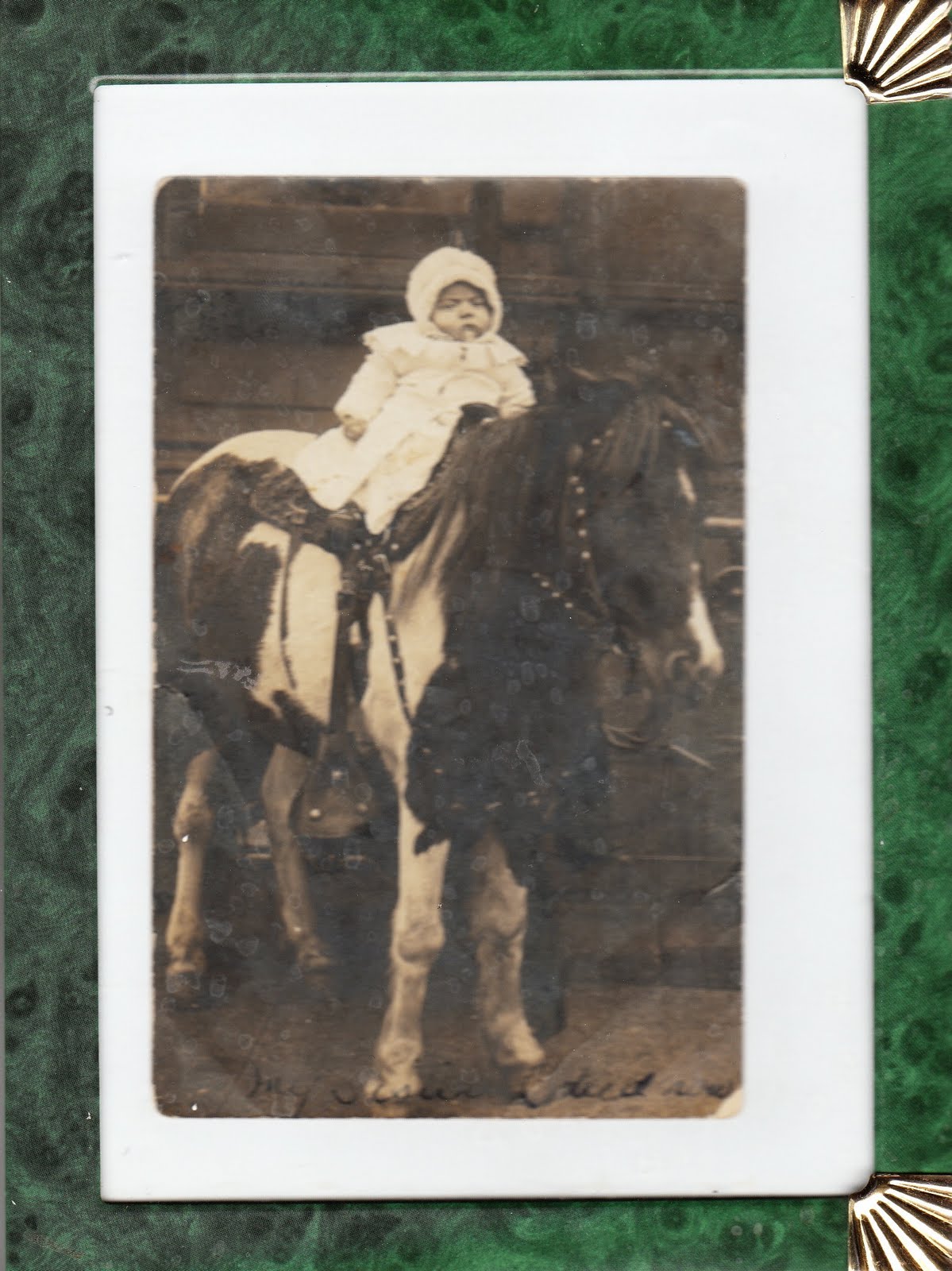
I was cleaning out old boxes of family photographs just before my Nanny's death. She was in her mid-80s at the time. Photo after photo I searched in wonder. Some had edges worn from too much handling, others with faces faded beyond recognition. I stumbled on a photo of a baby on a horse.

"Who's this?" I asked her.

She took the photo and looked at it.

"That's Josephine," she said.

"Josephine?" I asked. "That doesn't look like mommy."

"Oh no," she said, "that was the first Josephine."

I stopped and looked up at her, breaking my gaze into the box, quizzically.

"What do you mean the first Josephine?"

In her strong Italian accent she explained that her first baby, Josephine, died at almost a year old. Pneumonia, she thought.

I nearly gasped out loud.

"So my mom is the second Josephine, named after the first?" I asked her.

She went on to explain that she had a second baby the next year, very soon after the first Josephine died. She named the second baby Josephine. The second Josephine lived for six months and died in her sleep.

At this point, I felt utter disbelief. I didn't understand. Two, wait, three Josephines? Enter confusion, frustration, and language barriers.

Indeed. It was true. "But - how could I not have known? Why didn't anyone tell me?" I thought.

Nanny's third baby, named Mary, lived.

Her fourth, she named Josephine again, was my mother. The third Josephine. My mother was the third Josephine.

My mother, Josephine the III, died ten years ago tomorrow. I don't know where she is now, but I miss her in my life. My father, John, died six years ago tomorrow of what I'm sure is a broken heart, four years to the day after my mother. He was the first John, the only John. I miss him too. His parents had 14 children, many of whom died long before they did.

My mother's parents had five children. Five, not three. Josephine, Josephine, Mary, Josephine, and Salvatore.

Times were hard, indeed...

+++++++++++++++++++++++++++++++++++++++++++++++++++++++++++

Dear Mommy,

Tomorrow it will be ten years, an entire decade, since you left this Earth. How did that time pass so quickly? I am a daughterless mother and a motherless daughter now. And I miss you in my life. There is so much I'd share with you, much of which I'd have once been reluctant to share. There is so much I'd say to you, much of which I'd have once been too fearful to say.

I know you loved me now. I know why it was hard for you to show me. I get it. And I'm so sorry I didn't get it then. It's clear, so very clear now. And I feel I could've made it right. Damnit, I really miss you and daddy. And the kids miss you so much. And Joe misses you. And Mark and Eda and John.

I don't know where you are, but I can hope- can't I?- that you are with Chey, and Daddy, and Peppino, and your two Josephine sisters, and Nanny, and Grandpa, and all our other beloved Dead.

My throat is tight with sadness and I will cry many tears in the next few days. I remember the look in your eyes at the hospital. I remember watching them resuscitating you. I remember the anguishing life-support decision. I remember much that comes back to haunt me every Fall. But especially this year. Year ten. An entire decade.

Remind Nanny that she has five children, not three, and that I always remember them all, will you? Tell her that the first Josephine's photo is in my butsudan next to Chey's ashes. Nanny will understand that now, I'm sure. And tell daddy that I love him very, very, very much and that I forgive him, and that I'm sorry I was so willful and stubborn. I come by it honestly, you know?

Mostly mom, if you can hear this, tell Chey that I love her with my entire heart. I miss her presence in my life every day. I wish it was different. And that I'm sorry I couldn't save her. Let her know I've finally forgiven myself for that. Finally.

Thanks for visiting my dreams so often. And remember that I love you and I know you truly love me. I know. I know.

Joya

Friday, October 21, 2011

We exist. They existed. Please, see us.


Dear World,

We are men and we are women and we are gender-free...

We are Democrat, Republic, Libertarian, Independent, Green, Apolitical, and ...

We are rich, and poor, and middle class, and classless.

We are Christian, and Jewish, and Muslim, and Buddhist, and Sikh, and Hindu, and Wiccan, and Atheist, and ...

We are employed, and unemployed, and partially employed, and recklessly employed.

We are Irish, and Native American, and African, and French, and Haitian, and Romanian, and British, and Tibetan, and Italian, and Mexican, and Germanic, and Norwegian, and Jamaican, and ...

We are high school dropouts, we are college educated, and we are streetwise...

We speak one language or many languages, and we are from all parts of our Planet Earth.

We are young, and middle aged, and old, even facing our own death.

We are from the north, the south, the east, and the west.

We are a family of one, and two, and three, and ten...

We are both traditional and non-traditional families.

We are engineers, and janitors, and doctors, and teachers, and firefighters, and lawyers, and athletes, and marketers, and taxi drivers, and pastors, and rabbis, and elected officials, and administrators, and nurses, and maids, and childcare providers, and artists, and poets, and landscapers and...

We are tall, short, and medium, and emaciated and healthy and round and obese.

We are all around you, everyday. Everywhere you go, we are there, but you may not see us.

We are bereaved parents....

We have suffered life's worst tragedy. We have suffered a reality you dare not imagine.

Our children have died from birth to toddlerhood. From toddlerhood to young childhood. From young childhood to the teens. From the teens to young adulthood. From young adulthood into middle and late adulthood. Our loss is anachronistic, out of time, out of place. Our children died from cancer, and stillbirth, and fires, and car crashes, and SIDS, and murder, and suicide, and drug overdose, and drowning, and disease, and premature birth, and wars, and natural disasters, and congenital anomalies and...

Despite all the differences in who we used to be...

Now, we are bereaved parents. And siblings. And grandparents. And aunts, uncles, godparents, friends. And our lives will never, ever, ever be the same. This common thread is woven through our lives, and will remain part of our painful tapestry from generation to generation. Our grief is not contagious. It will not make you sick. It will not cause those you love to die. You are already vulnerable even though you may not realize it. Grief is simply an expression of love; hallowed love with no where to go except to be enacted through our mourning tears, through remembering them the rest of our days.

You can help us.

Please visit the front page of the Arizona Republic to learn more about federal legislation for all bereaved parents.

Then, please, support us by signing this petition and emailing your Congress women and men and asking them to sign on to and support this important legislation.


We are bereaved parents. We are one, despite our differences. Our grief unites us.


Becoming...

""""""""""""""""""""""""""""""""""""""""""""""""""""""""""""""""
The soul still sings in the darkness telling of the beauty she found there; and daring us not to think that because she passed through such tortures of anguish, doubt, dread, and horror, as has been said, she ran any the more danger of being lost in the night. Nay, in the darkness did she, rather, find herself.

--St. John, Dark Night of the Soul


Follow me on Facebook